
As a sales professional in the real estate sector, you know: Investors demand clear facts on returns and taxes before they make a purchase decision. Listed properties offer a strong argument, especially for high earners – with high depreciation and stable returns. This guide summarizes the most important facts about listed properties as an investment.
What are listed properties?
Listed properties include buildings with historical or artistic value, such as town houses in Munich or old factories in Leipzig. These properties are usually visually impressive due to their architecture, for example their elaborately designed facades, which enrich their neighborhood.
As they are often buildings with a long history, listed properties are particularly worthy of protection and are therefore protected. In order to preserve them, extensive renovation and modernization is often necessary. Although the Office for the Protection of Historical Monuments makes special demands on structural measures, these are usually subsidized.
Listed properties are also something special from a financial perspective. Historic buildings are often more expensive than other types of property. Depending on the property, the tax office grants high depreciation and tax benefits to relieve owners of renovation costs.
From the property investment to the sale. All in one system!
EXCLUSIVE: Access to first-class capital investments!
Why are listed properties worthwhile for investors?
Listed properties are smart investments whose tax advantages generally outweigh those of conventional real estate. Listed building protection by the state authorities ensures value stability as long as planned renovations are approved.
Monument depreciation
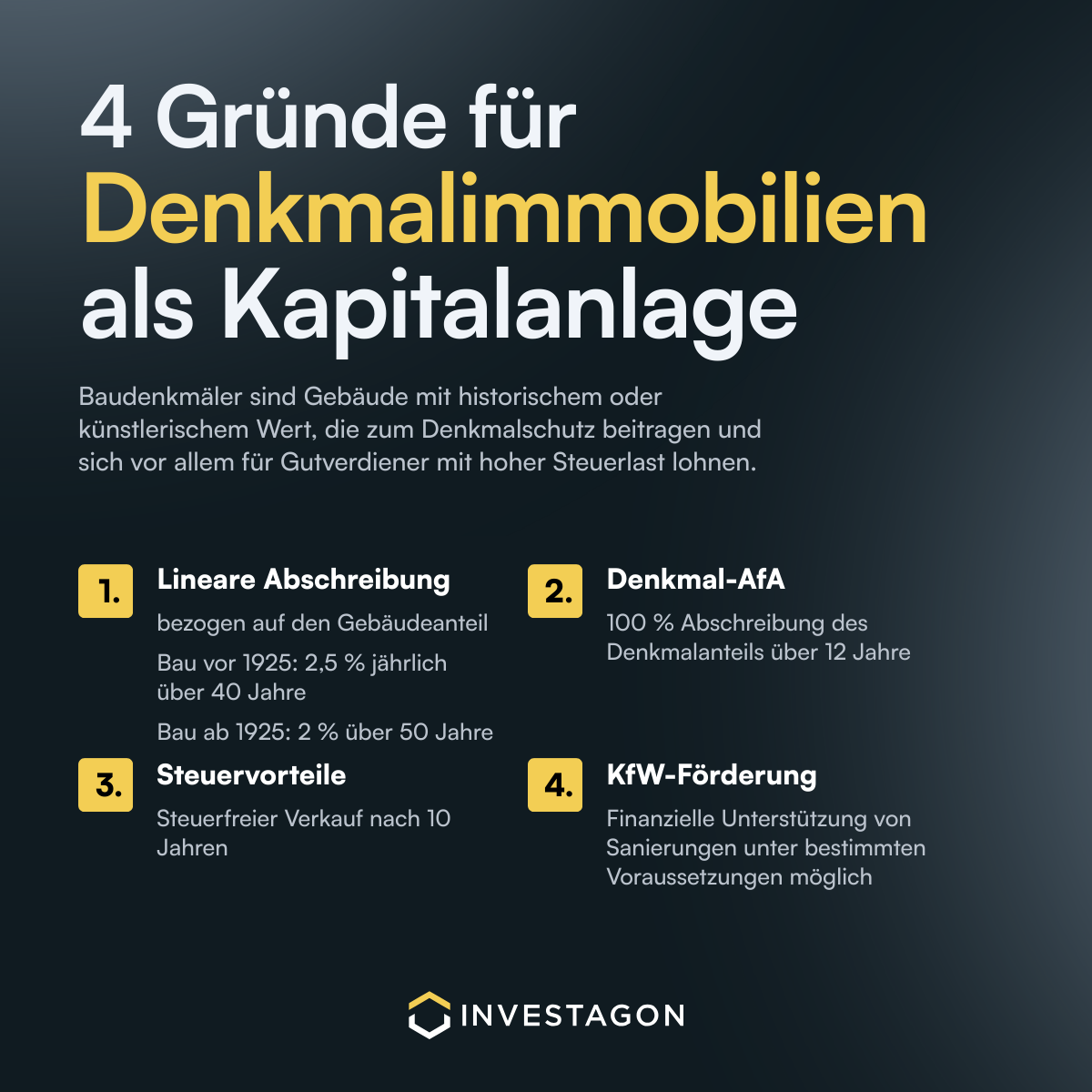
The greatest leverage lies in the deduction for wear and tear (depreciation) of the listed portion, i.e. the part of the building portion of the property without land that is listed.
Landlords who modernize their property after purchasing it in line with listed building requirements can write off 9% of the production costs for tax purposes in each of the first eight years and 7% for a further four years.
Over a period of twelve years, they thus achieve a total depreciation of 100% of the monument share.
Straight-line amortization
In parallel to the depreciation of listed buildings, owners benefit from straight-line depreciation of the building portion. For properties built before January 1, 1925, straight-line depreciation of 2.5% is applied annually over 40 years; for buildings constructed after 1925, the annual depreciation is 2% over 50 years.
Advertising expenses
In addition, all financing costs, including loan interest, bank fees and land registry costs, are deductible as income-related expenses when renting. Particularly in the initial phase of financing, this can lead to an almost tax-free rental, as the income is fully offset by depreciation and costs.
Tax advantages on sale
When the property is sold, the profit made is completely tax-free after a holding period of at least ten years – a considerable advantage over other investments.
KfW subsidy
Renovations are necessary to ensure that historic buildings are preserved for a long time and do not become energy guzzlers. The KfW offers funding programs to relieve investors of the financial burden of refurbishment measures. However, listed buildings must meet certain requirements to qualify for funding. Good advice is essential for investors.
Potential returns and risks of listed properties
Listed properties are a genuine investment. Due to the tax advantages, investors can achieve a return on equity of 15 % and more. However, they also have to accept risks. Renovation costs and bureaucratic effort are higher than for other types of property.
How do you sell listed properties successfully?
However, many risks can be reduced through predictable depreciation, transparent property information and professional appraisals. Listed properties are an exciting investment opportunity and a real tax break, especially for customers with high incomes.
However, it is important to prepare property information and tax-relevant facts to a high standard and to tailor them precisely to this demanding target group.
Digital tools such as Investagon support you in this: With the real estate software, you put the tax advantages of your listed buildings in the right light and provide your customers with convincing arguments to buy.
Sales via the largest network for investment properties
With Investagon, you can reach up to 90% of the relevant distributors and property providers throughout Germany.